
Co-Editor-in-Chief ABIGAIL LALLY reviews Christina Mackie’s first solo institutional show in the UK in over a decade.
Spanning three rooms upstairs at Goldsmiths Centre for Contemporary Art, Material Reality makes clear why Christina Mackie (b. 1956, Oxford) remains such a distinctive figure in British art. She defies easy categorisation: her practice floats between media while staying firmly anchored in material, process, and the vast, often unsettling scales of time. She works across sculpture, film, and painting, and is equally attentive to geological and environmental processes as to the digital and scientific tools that now shape how we measure and understand the world.
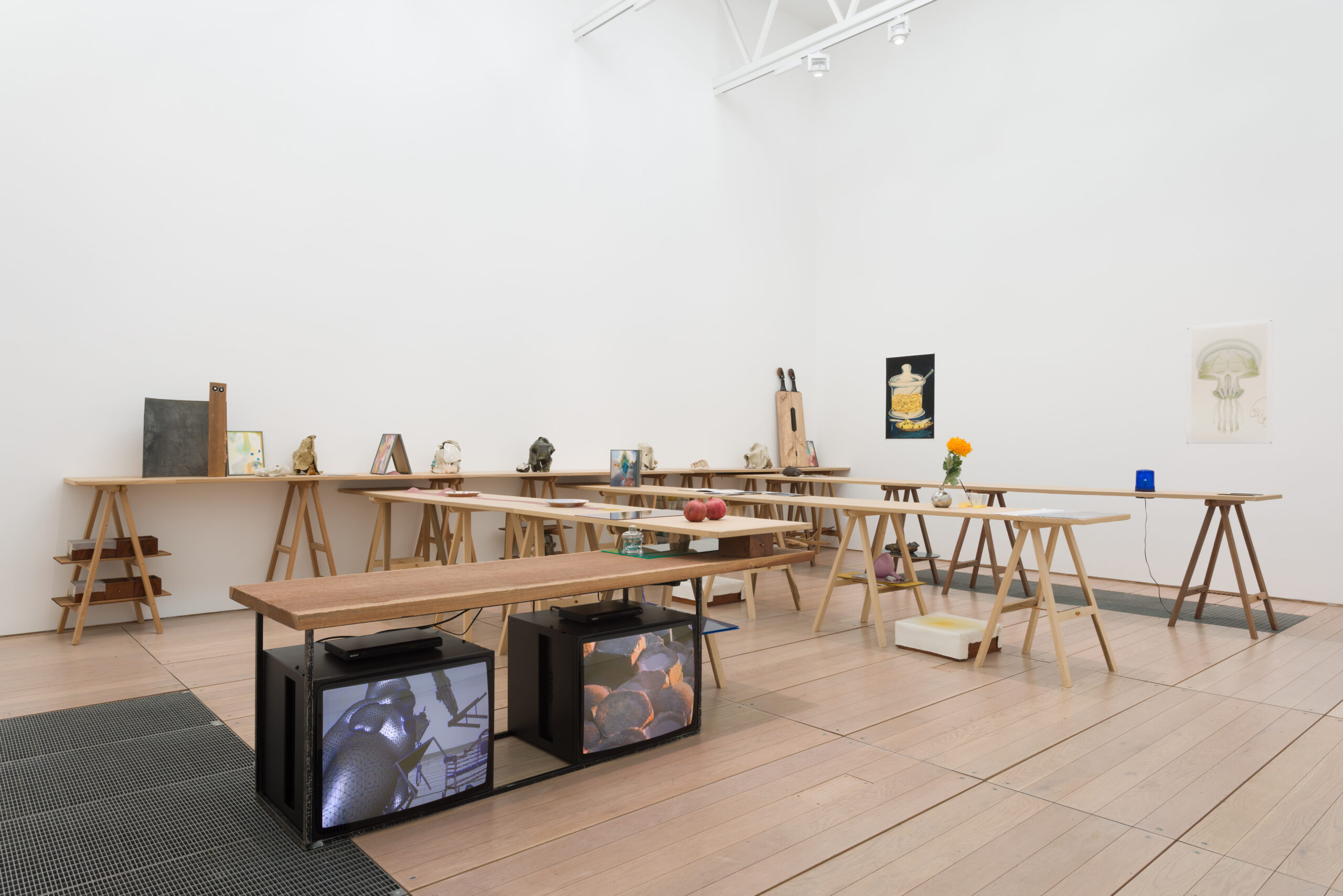
At the top of the stairs, you pass through the Bridget Riley Gallery, where Mackie’s installation The Judges II (2011-12) spreads across a cluster of handmade trestle tables wrapped in brown paper. The work came about after her visit to the site of an extinct volcano, and contemplates representations of time, as mediated by geological spans and pressure-forces. Part-studio, part-archive, an assortment of objects are neatly arranged across the tables, and leaning against the surrounding walls. Being the most recent iteration of this work, it is interesting to see how subtle alterations reflect her current practices and concerns.
Small watercolour paintings, organic sculptures, two pomegranates, an artificial marigold flower, a pink plastic funnel, a police emergency light, and a bundle of wooden sticks are among the objects on display. Here, Mackie draws our attention to materials at every stage of their formation; paint comes from pigment, sculpture from slip, and so on. The most striking of the selection is the white, spotted ceramic plate covered in pink sand, that appears to have drifted across the surface, forming little dunes down the length of the table. Beneath one of the tables, two video works are shown side-by-side. In Planet and Fall Force, she explores landscapes, and crystal-formation. Ultimately, Mackie is interested in how one day this “paraphernalia of the studio” will all become dust.
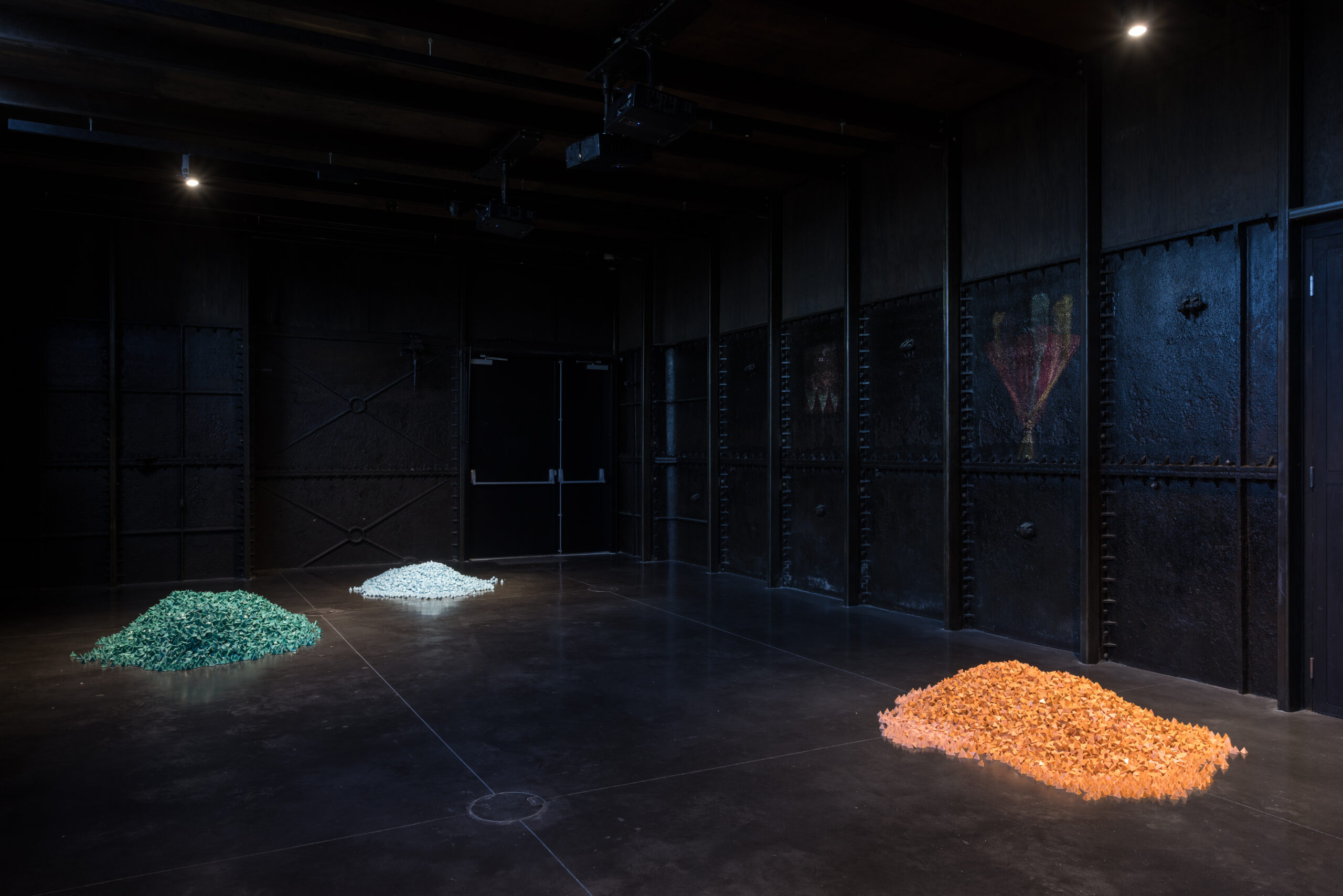
It was a delight to finally see Powder People (2018), perhaps her best-known work, and to see it exhibited in the UK for the first time. The work was originally made for her exhibition People Powder at the Spazio Culturale Antonio Ratti in Como, in the former Chiesa di San Francesco. A far cry from the medieval church it was conceived for, the Daskalopoulos Tank Gallery at Goldsmiths CCA transforms the experience of the work entirely. Here, in this ex-Victorian water tank with its metal-lined walls, you’re swallowed up by the darkness.
Each wall displays a kaleidoscopic animation of moving particles flowing in and out of narrow passages. Mackie took inspiration from the way that people move in crowds, how they weave between each other. Made in varying, delicate pastel hues, four piles of polyester tumbling media occupy the floor—they’re meant to be the flowing particles in solid form. These are cone and pyramid-shaped abrasive materials, used to polish or finish manufactured parts in a rotary machine. I imagine the tumbling media look more at home in this industrial space than the Chiesa di San Francesco. Nearly eight years later, the work remains strikingly pertinent, especially in relation to Mackie’s continued interest in data, its mining and uses, and the accumulation of information. On my second loop around the exhibition, however, I spotted something strange. The room had become much busier, and people were picking up handfuls of the cones, casually tossing them back into the pile. I’m not sure that was allowed. There was maybe some irony in this, though—the crowd mirroring the animations mirroring the crowd.
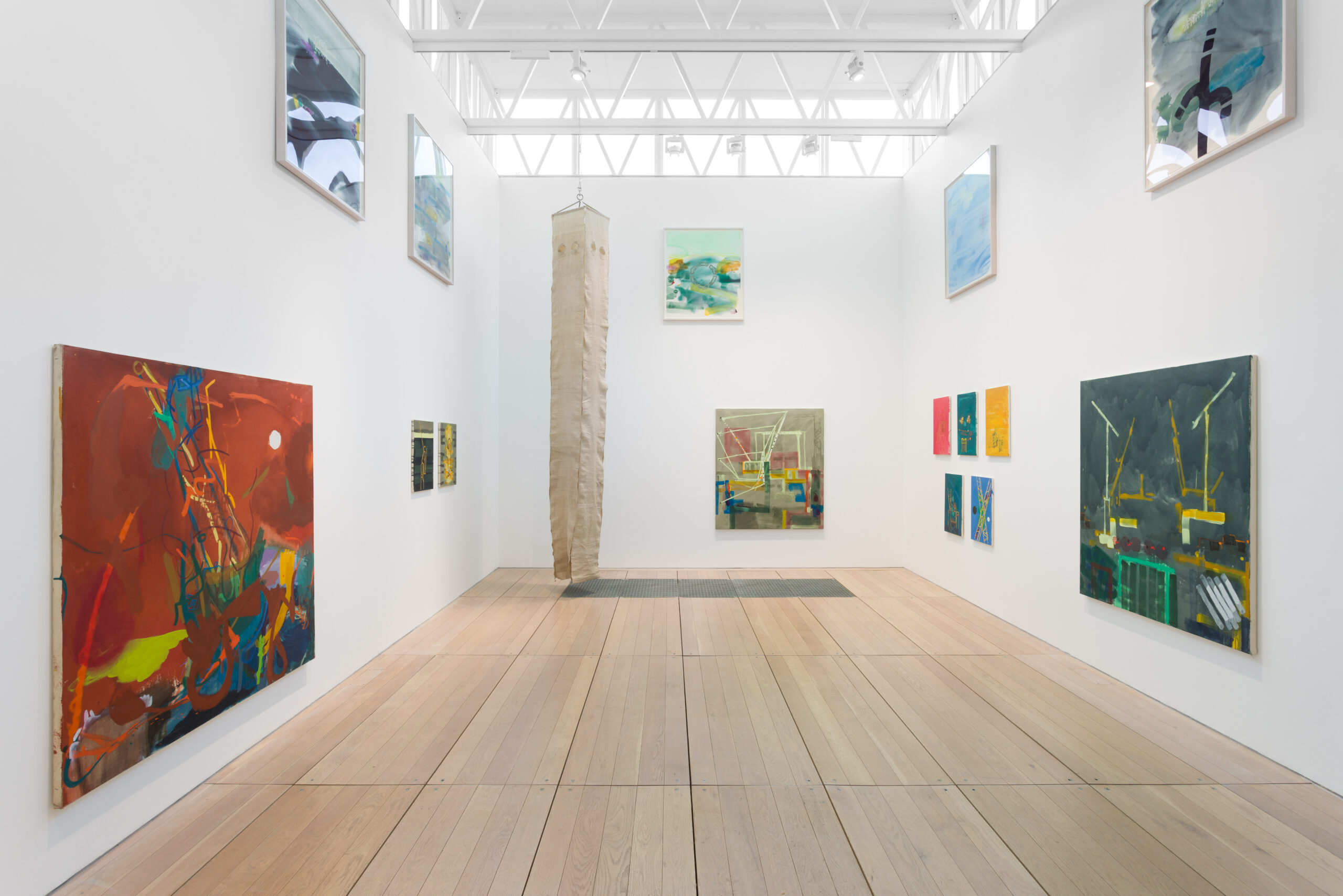
Dissolve (1985-2025), on view in the Clerestory Gallery, is a new installation that spans watercolour, oil, textile, and film. In the far corner, a towering linen sculpture hangs from a ceiling beam, reaching down to the floor. Pairs of eyes are subtly embroidered onto the upper section of the fabric, at eye-level with those richly coloured oil and watercolour paintings mounted high on the walls. These works, as well as those lower-down, depict the view from her cabin on Mayne Island, looking out towards the Port of Vancouver. This same scene is shown in a calming, looping video positioned at the entrance of this room. The juxtaposition is quietly charged: from a tranquil, pine-covered island just across the strait, she observes the vast, humming global shipping industry.
Though I visited in the evening, it is worth noting that the artist made the deliberate decision to—for the first time ever at Goldsmiths CCA—remove the window coverings in each of the galleries. And so, even on the bleakest day of London’s winter, light will stream into this tall, airy space, gently altering the hues of these canvases throughout the day. Thanks to some unusually productive eavesdropping, I learned that Mackie was closely involved with the installation, remaining on site throughout to oversee the installation down to the most minute details. An exhibition so carefully controlled, yet open to change; fixed in its material arrangements, but continually transformed by time, light, and the environment.
Featured image: Installation view, Christina Mackie, Material Reality (30 January –19 April 2026) at Goldsmiths Centre for Contemporary Art. Courtesy Goldsmiths CCA. Photo: Rob Harris.