
ALESSIA DORAN reviews blockbuster exhibition Dirty Looks: Desire and Decay in Fashion, reflecting on “the nostalgia of mud”.
Of all the ways fashion has chosen to rebel, the use of dirt and decay may be its most fascinating yet. Humans have long had a strange attachment to the “lived-in”, and playing on this sentiment, the Barbican’s Dirty Looks exhibition showcases clothes that have clearly been affected by their environment, function and human fallibility. Coined by French poet Émile Augier in 1855, the evocative term “nostalgia of mud”, captures this enduring fascination. The idea that dirt and decay symbolise human connection to the natural world and a rejection of industrialism has engaged many designers, leading to a well-established trend of ragged fashion. Featuring a range of works from wine-stained dresses to soil-aged garments, Dirty Looks explores the interplay between nature, transformation, and imperfection.
The exhibition opens with a minimalistic display: two pairs of wellies side by side—one pair pristine, the other caked in mud. The spotless pair belonged to Queen Elizabeth II; the other was supermodel Kate Moss’ iconic Glastonbury wellies. Though visually unassuming, both boots—like case studies of sorts—speak volumes about the diverging cultural narratives of status and identity.
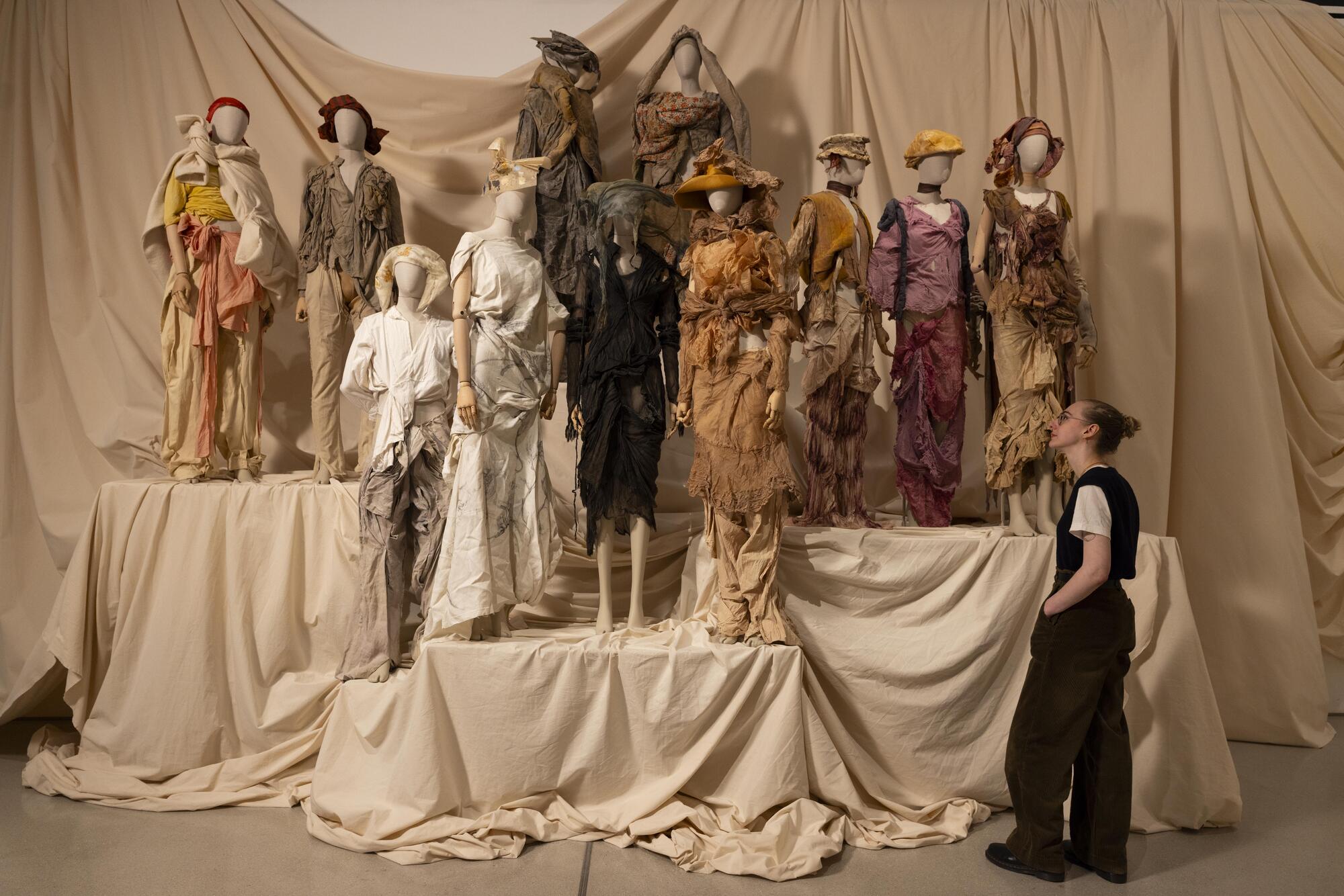
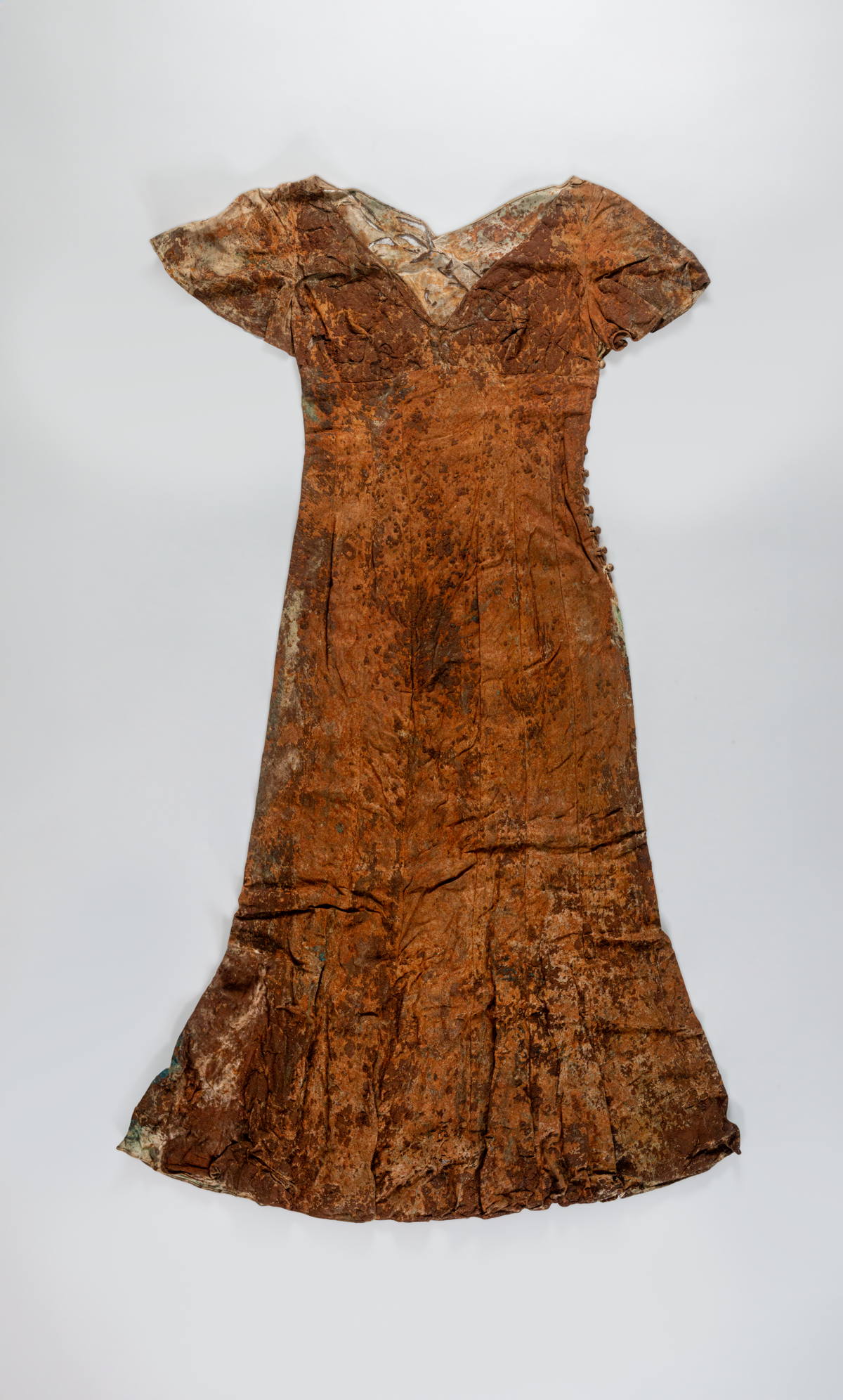
The exhibition proceeds to the first room, dedicated entirely to the work of Turkish Cypriot designer Hussein Chalayan. From the onset of his career in 1993, Chalayan has explored the relationship between fashion and the earth through various mediums. His Central Saint Martins (CSM) graduate collection, The Tangent Flows (1993), featured garments created through a process of soil burial and subsequent unearthing, performed shortly before the final show. The fictional narrative behind The Tangent Flows imagines a group of female performance artists striving to merge Western Cartesian tradition with Eastern philosophy through their work. They are prosecuted, stoned to death and buried by the followers of the Cartesian canon. Inspired by the created image, Chalayan buried the garments in his friend’s backyard, leaving the clothes to decay over several months, and unify with the elements of their earthly environment. Allowing nature to tell the designer’s story,transforming his garments without any human interference, manifests a refreshing antithesis to today’s overly synthetic fast fashion culture.
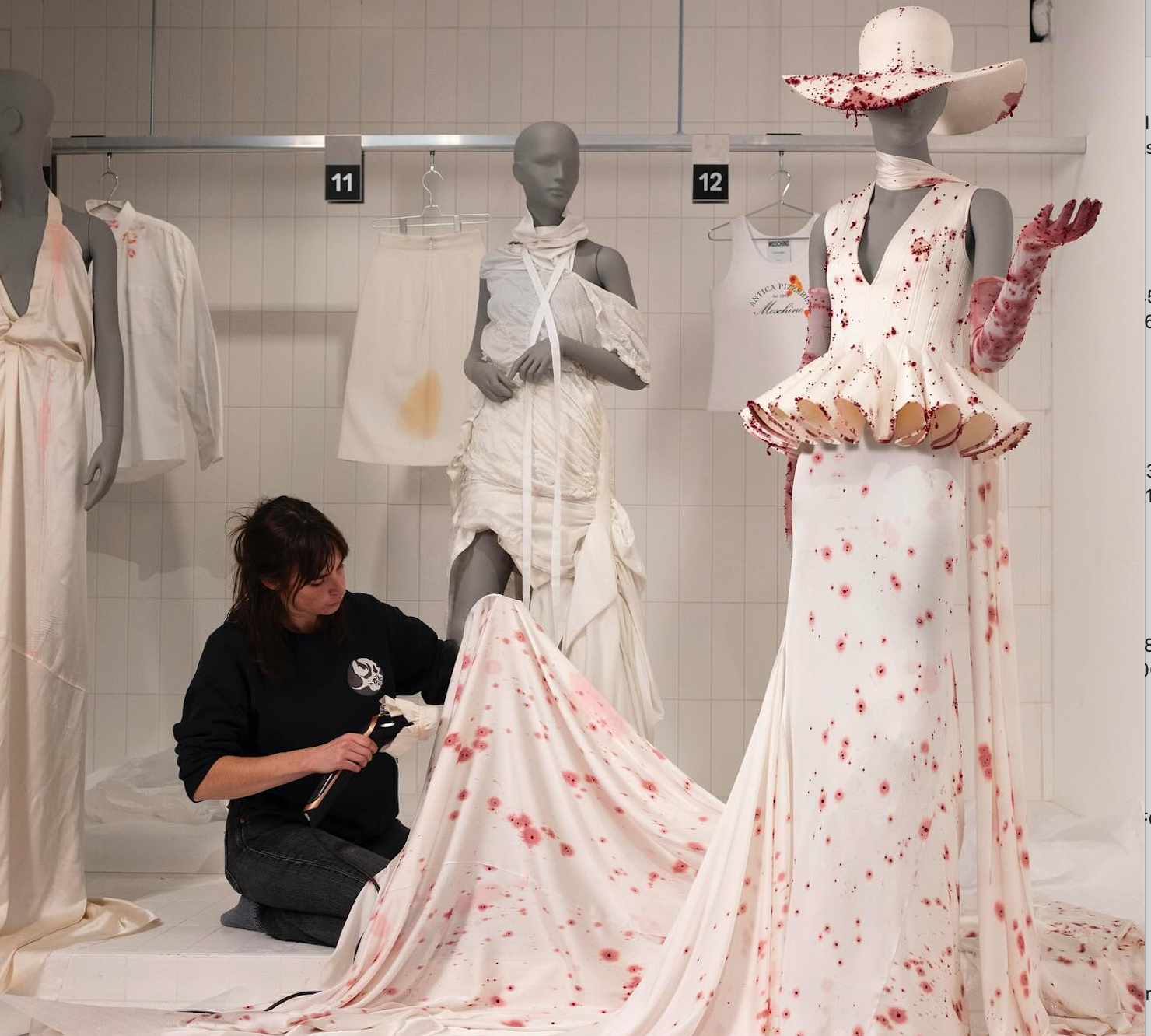
Although slightly overcrowded in terms of display, another room I particularly enjoyed was titled “Stains as Ornament”, which challenged the perceptions of stains as shameful mistakes. Stains are generally seen as marks of dirtiness and mishap—a failure to uphold cleanliness. But what if we used stains deliberately to contradict the established perception? This was the question posed by such designers as Maison Margiela, Rick Owens, and Robert Wun, who employed intentional staining to explore the beauty of the accidental. Whether stained by wine, pizza, lipstick, or mud, the garments in this room serve as direct explorations of human fallibility. Robert Wun’s The Wine Stain Gown (S/S 2023, Fear) was a highlight for me; his use of real red wine along with Swarovski crystals creates an unconventionally elegant example of a beautiful accident. Yet for many, stains aren’t fashion choices but inevitable by-products of labour, scarcity, and limited means to buy new clothes. Thus, we face a curious problem: high fashion frequently misappropriates the indicators of financial hardship, aiming to imitate the aesthetics of the lower classes.
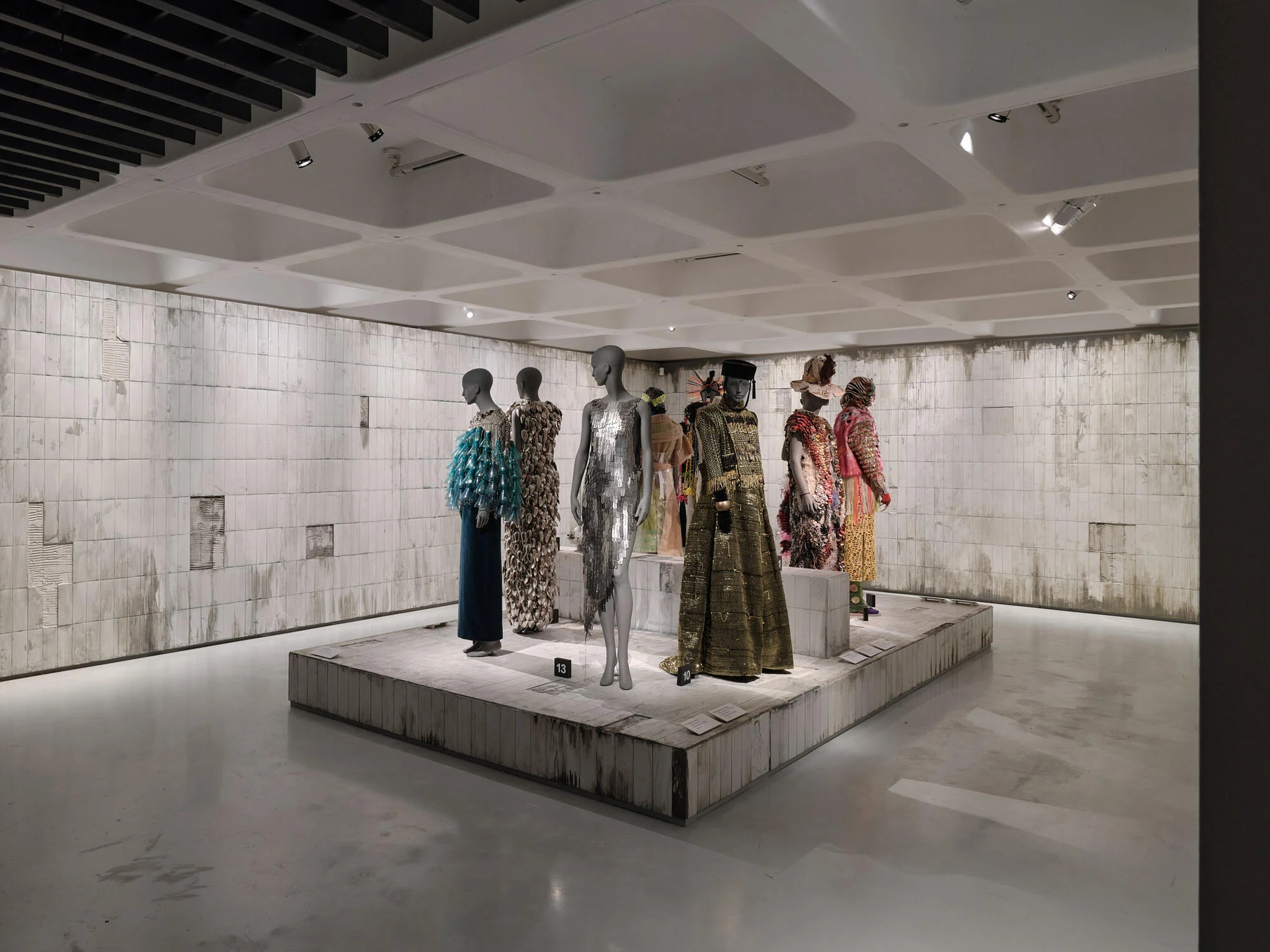
In the “Glittering Debris” section, found objects constitute new creations. The designers behind the works featured in this room took the idiom “from trash to treasure” literally, through their artistic use of waste and household objects. These works celebrate the quiet beauty of the discarded, demonstrating fashion’s capacity to connect with natural cycles of decay and renewal. For her 2023 CSM graduate collection Crocodile Tears Liqueur, London-based designer Ayumi Kajiwara created a series of wearable art pieces. One of her pieces in the exhibition was made from discarded bottle caps and waste yarn;seeing each individual bottle cap left me wondering whose lips had touched it and what stories it bore.
While the upstairs is organised thematically, with linking conceptual motifs, the lower floor of the exhibition centres around individual collections. While perhaps lacking a strong sense of continuity, I was captivated by each exploration of the exhibition’s theme. It also allowed individual designers to stand out: Solitude Studios, who left their garments to age in a Danish bog for several months for their S/S 26 Before the Orgy collection was a highlight. Ultimately, Dirty Looks succeeds in offering something for everyone: a provocative experience that challenges perceptions of beauty, imperfection and our relationship with nature.
Dirty Looks: Desire and Decay in Fashion runs at the Barbican until 25 January 2026. Featured image courtesy of David Parry and the Barbican Art Gallery.