
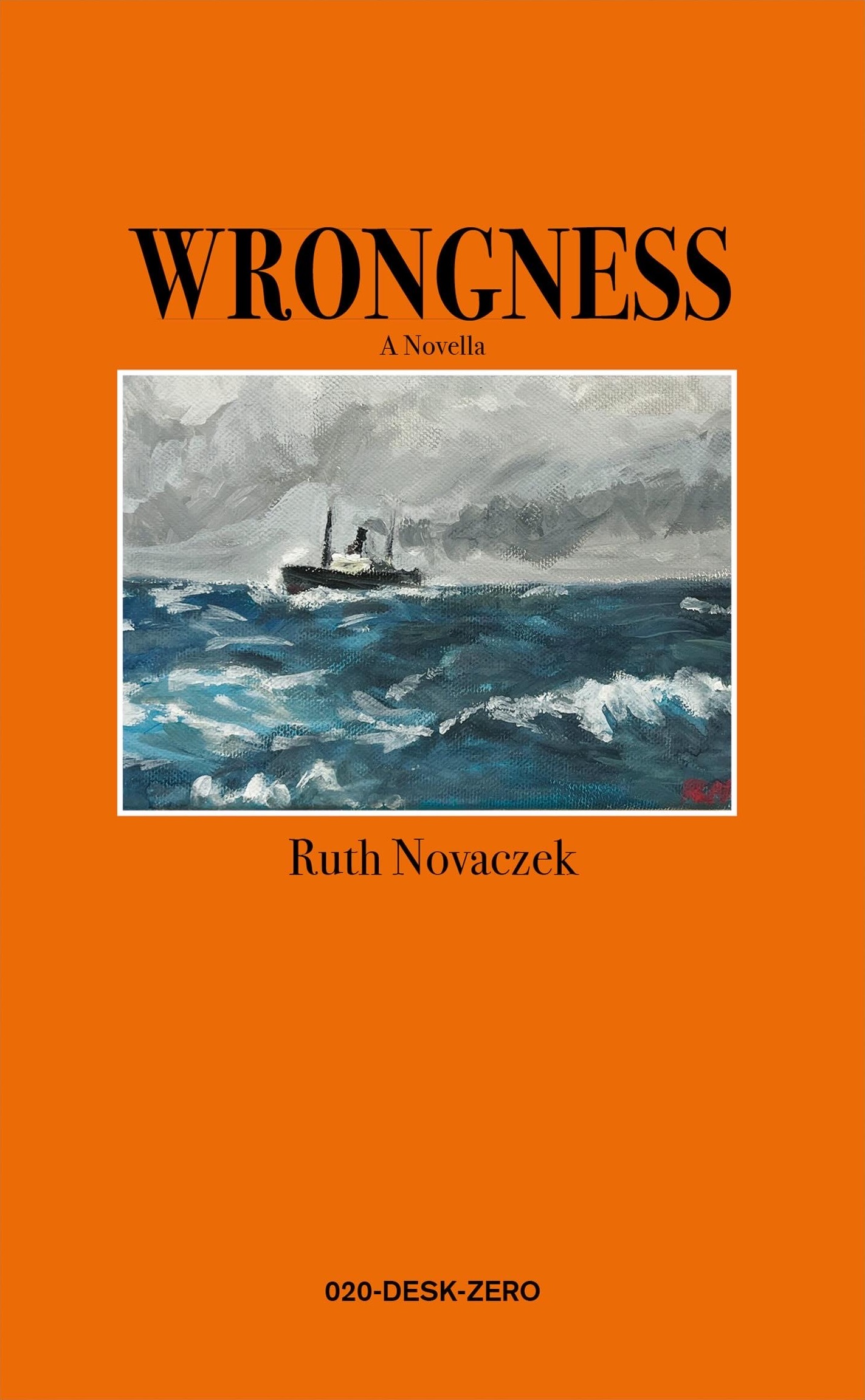
Literature Editor CSENGE GY reviews Ruth Novaczek’s Wrongness.
Wrongness is a struggle with time, wrapped in the recounting of an untethering love affair. It is a diary enveloped in letters – addressed to an unnamed “Dear…” – and introspections enveloped in retrospections.
The novel plays out as a stream of consciousness – an unstoppable succession of memories and thoughts. Anecdotes overlap, phrases undo each other, the past and present pool within singular sentences. The reader is constantly re-contextualised, never permitted stillness. This overwhelm breaks down the conscious barrier between self and speaker, pulling us, with great force, into the lovers’ whirlwind.
“We were born almost four decades apart, I’m having trouble with time.”
This “trouble with time” threads throughout. The past and present tense intersect with each other, colliding. The emotional and temporal disconnect between the lovers is evoked, replayed to the reader through the disjointedness and deliberate refusal of chronology.
Questions and pieces of dialogue go unmarked. Thoughts are self-interrupting, responses anticipated: even the inner thoughts of the speaker are mediated by the lover.
“I don’t want to be anyone’s tamed creature. But I don’t mind adapting.”
Language is unstable, self-contradicting. Meaning forms, then cancels itself out, replicating the cyclicality of their turbulent love; one that builds and breaks , on repeat, endlessly.
“I thought it was a love story but it wasn’t. And it was.”
The instability of their intergenerational love affair spreads to the form itself, rendering language volatile. The love letter is complicated by the uncertainty of the love itself, becoming formally contradictory: they are letters never intended to be sent, self cancelling by design.
“This is a love letter but I’m not trying to get you back.”
Towards the end of the novel, the epistolary form almost entirely disappears. Second person addresses fall away, the novel turning more overtly journal-like, through which the entire novel is reframed. These are a series of love letters, yes, but written to the speaker herself. They are love letters of self-love, unpacking the affair in an effort not to rekindle it but to understand and self-validate it. These letters are attempts at unravelling the past to make space for new futures; ones unthreatened by the weight of what remains unresolved.
“I felt doomed, lost in a blurred future.”
Novaczek’s remoulding of form and language opens up new possibilities for expression, filling the gaps where language falls short, the space between sign and signifier. This manifests in her creation of new words, akin to kennings, “soul-broken” for instance. Where existing language proves inadequate to express the depths of her emotions, she carves new forms of language that can accommodate.
Wrongness is unashamedly honest and unconventional. Its conscious refusal to be simplified or chronologized, in some ways to be understood entirely, is precisely what sits at the root of its relatability, its intense resonance.
Filmmaker Ruth Novaczek’s first work of prose, Wrongness, is published by 020-DESK-ZERO, a 24-hour poetry phoneline-turned-press.