
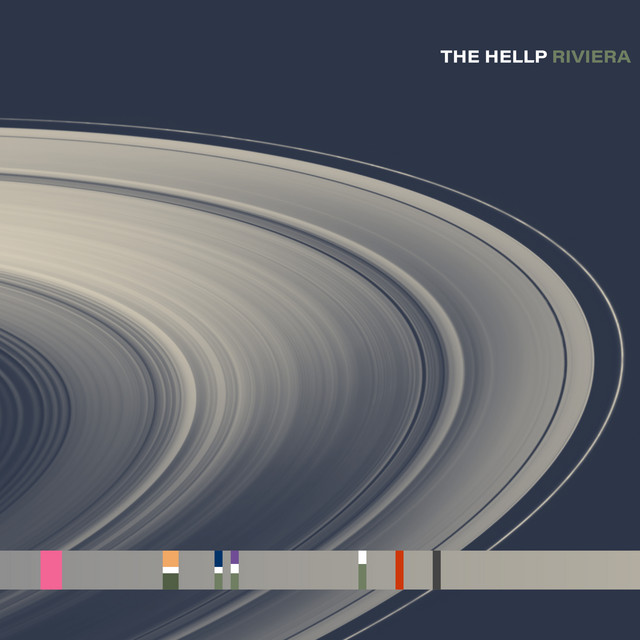
Music Sub-Editor GEMMA-REESE ROGERS reviews The Hellp’s third album Riviera.
It is reductive to believe that The Hellp have never engaged in curating their own form of Americana music—in fact, it’s arguably one of their main objectives. After ten years of releasing divisive, genre-bending sounds, Noah Dillon and Chandler Ransom Lucy are still turning heads. Just over a year after their hyperpop-heavy LL (2024), the band released Riviera, a concise ten-track record. With more allusions to the unashamed grit of earlier projects Enemy and Vol. 1 (2021), The Hellp generates a sound that tackles the uncomfortable questions the duo pose to their country, gift-wrapping it in a sonically sophisticated sheen. Described by Dillon as the “disparate” Americana that can be found on the West Coast in a recent interview, Riviera concerns itself with constant journeying to a place that is never fully realised anywhere within the album. This odyssey is an unusual one: there are no glorified heroes or satiating homecoming at its end—instead, Riviera fixates on the peaks and troughs of the American experience entirely.
The opening track, “Revenge of the Mouse Diva”, immediately delves into handling the “grenade” of fame fearlessly. Named after Rhonda Lieberman’s essay on Karen Kilimnik (1994), it is an intriguing nod to Franz Kafka’s titular character from Josephine the Singer, or the Mouse Folk (1924). She chooses to walk away from the relentless demands of artistry and consequently curse herself to oblivion: to be forgotten by her equally onerous devotees. Such sentiments are reflected in the moody guitar riffs and drums of the song that are lost and recovered again within an interlude of distorted screams, muffled piano keys and laughter. It registers as a fractured anamnesis, a pained reflection of a past life. Riviera’s starting point, then, is sonically viscous. Listeners are forced to traverse through ambiguous memories weighted with paranoia (“They’ll get you / They will get you if you let them”) that are hastily shelved as “just a dream” by the end of the track. The song’s creation serves to not only preserve these uncomfortable feelings, but obliterate them at the same time—revenge served in a way only The Hellp can pull off.
Riviera draws on American cultural sources well: second track “Country Road” interpolates John Denver’s 1971 anthem “Take Me Home, Country Roads”, to fit the lived experiences of Dillon and Lucy (“But this ain’t West Virginia / This is LA”). Despite the aged reference, there is not a song on Riviera more refreshing in its production—the focused beat is pointed, like repeated lashes from a whip, relentlessly steadying the tempo. The lyrics seem to have an epiphany of their own, realising their disconnect to the instrumental’s direction part-way (“But I’m not there and / I never really was but / I’m really not here either”): they demonstrate a state of uncertain California wanderings despite its clean-cut foundations.
Maggie Cnossen, a visual artist and the band’s “day one” plays a critical role in ensuring that Riviera’s messages do not arrive stale. She literally and figuratively becomes instrumental to the album: from her crisp questioning on “Country Road”, to the climactic intertwining of mantras with Dillon on the gorgeously cinematic track “Here I Am” (“From LA to LA (When it rains) / La-la-la (You get wet)”, Cnossen playfully engages with pre-established sentiments of feeling static or unsure on Riviera, giving listeners a new, relaxed perspective on them.
“Modern Man” is Riviera at its most overtly frustrated: it is the record’s most basic song in message and composition. At times, it feels as if it circumnavigates where the heart of the song should be. There is a disappointing commercial emptiness to its layers, but perhaps that is precisely the point of its jarring simplicity. The diptych of New Wave America and Cortt nestled in the middle of the album, however, is far more exciting. Framed by the seductive utterances of Sophia Álvarez, this is where a true Riviera sound is given room to develop. What forms is a microcosm of a romantic tragedy that culminates in inevitable loneliness. The album’s motif of a “hard drive” into the city is most poignant in “Cortt”—tensions between origin and destination have never been so high.
By the time we reach the final track, “Live Forever”, we have traversed the American dream and circled back to fight against fame’s narcissistic impulses. This is Riviera at its best—with synths that are reminiscent of blaring foghorns against a fast-paced, urgent beat. The lyrics match this intensity—constantly battling ideas of (“I want to fade away / I wanna live forever”) over and over again. The lyrics take us through beautiful snap-shot vignettes: from rainbows to intimacies in grasslands, the narrative seems to flicker between a romanticised rural experience and the haunting obligation to assimilate with the urbanised America that everybody else pretends to be comfortable with. You’ll feel simultaneously attracted to and disillusioned with the depiction of America you’ve spent the last thirty-seven minutes listening to.
Despite its relatively standard length, there is something surprisingly epic about the record. Its thematic and emotional vastness can be felt in its depth of lyricism, meticulously layered production, and its success in not completely condemning LA or the agrestic settings that are constantly reminisced on. I initially hesitated to call it a work of electro-pastoralism as I feared the term rendered the project two-dimensional. But all things rural are handled with such tenderness, irrespective of the brash electronic experimentation that The Hellp are recognised for. Ultimately, Riviera’s most admirable quality is its ability not to lecture at or entrap listeners in anything too predictable—just like its artists.
Riviera, released on Friday 21st November, is available on all major streaming platforms.
Featured image courtesy of Spotify.