
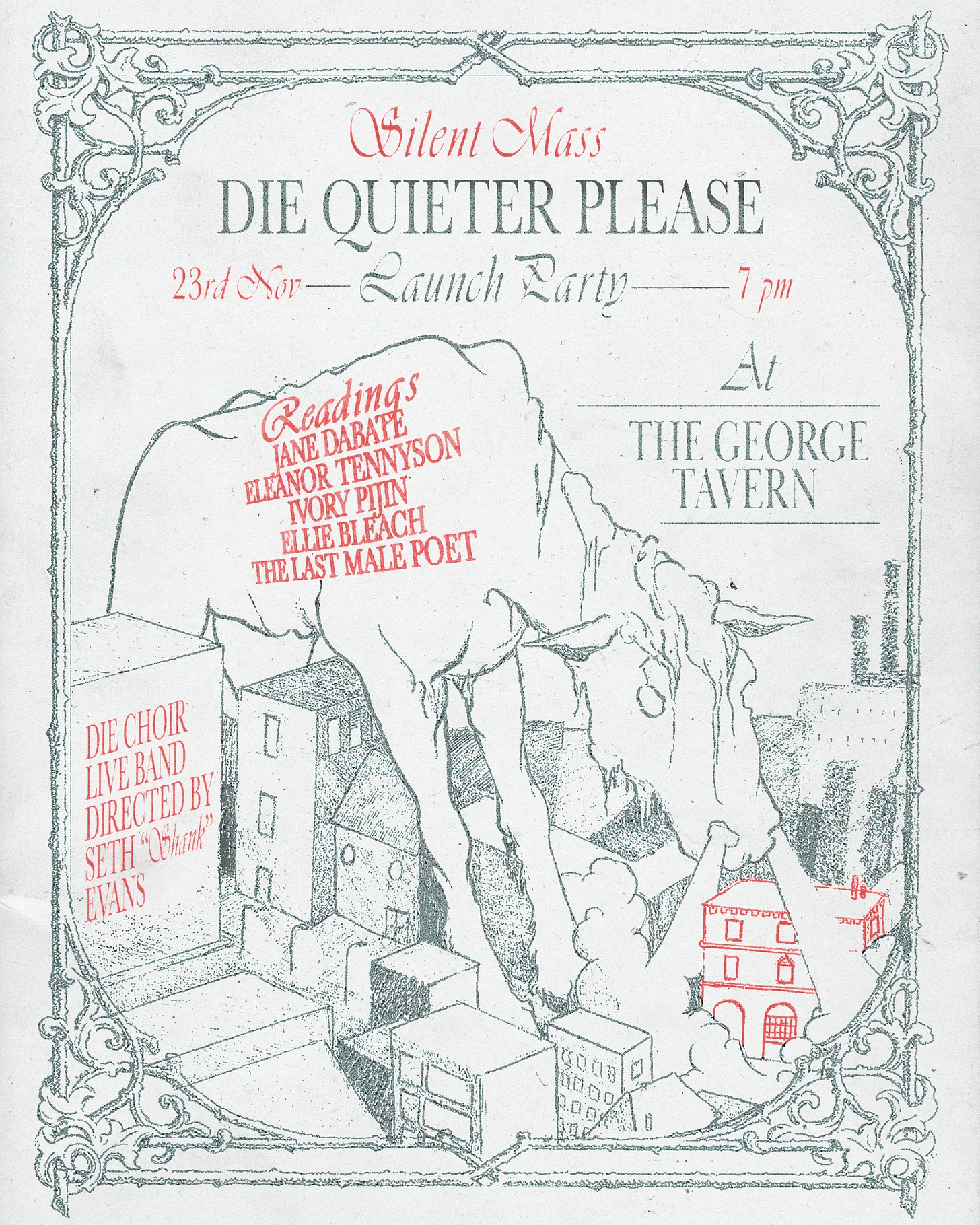
Literature Sub-Editor MADDY JOSEPH reads Silent Mass, the third issue of Die Quieter Please, and speaks with its founding editor Frankie Faccion.
On Sunday 23rd November, Shadwell’s iconic grassroots venue The George Tavern hosted an evening of music and reading to celebrate DIE QUIETER PLEASE’s launch of its third issue, SILENT MASS.
The launch party brought the issue to life through readings by contributors accompanied by live music. As the night unfolded, the venue gradually filled with twenty-two to thirty-something London creatives and middle-class literati.
Founding Editor Frankie Faccion explained that fellow editor Rene Hrustic first proposed the theme SILENT MASS. The phrase, originally Croatian, refers to the “silent treatment” that follows an argument or fight. Faccion described envisioning a silent mass as a post-conflict landscape, asking contributors to explore the aftermath: “What do you do after the worst thing that could have happened has happened?”
The magazine’s introduction sets the tone: “SILENT MASS finds you bruised and battered, keeled over in an alleyway, in a moment of silence after conflict. A baby speaks to its mother about a former life of bourbon and motorcycles. A psychiatrist confronts his sordid past from across the dinner table. A last will and testament contains an otherworldly reptilian burden. A scurrilous politician falls from grace at the end of war”.
In conversation, Faccion reflected on her editorial process for this collection: “We like stories that are genuinely entertaining, and don’t tend towards navel-gazing. We’ve published genre fiction, political farce, stories about inheriting giant reptiles, eating zoo animals, and having surreal transcendental experiences in hot tubs. We like people who can use their imagination”.
This unsettling yet imaginative collection features eighteen pieces ranging across flash fiction, poetry, and prose. The writing is accompanied by haunting charcoal illustrations by art director Anna Hindmarch. These traditional drawings are designed to “accompany the stories without imposing too harshly upon the already vivid imagery throughout our writers’ work”.
The performances opened with Jane Dabate’s reading of Who’s Jorge, a subversive flash fiction piece about a devout single mother whose life is transformed by the birth of her child. Meditations on the transformative power of childbirth quickly slip into revelations about the baby’s past life as “Jorge Aragon, son of motorcycle man Ricardo ‘Rick the Prick’. The shifting perspectives between Jorge, the mother, and the baby produce a surreal, witting effect. The tone is quickly shifted with Ivory Pijin’s reading of his gothic experimental short story Banana Bread. The narrative centres on a girl filled with “blood lust”, “nihilism” and “penis envy”, who murders her mother to break their mundane, loveless co-dependency. Pijin’s acute attention to detail puts the horror and dark humour of the prose at its forefront.
Eleanor Tennyson’s Tony Triptych followed—a three-part experimental piece addressed to the elusive figure of Tony. Through the voice of someone “addicted to sensation”, the work questions the possibility of emotional and sexual connection. Ellie Bleach delivered a deadpan reading of her eerie and absurd flash fiction piece Crocodile Story next. In her performance, Bleach assumed the persona of her protagonist Jim Blemkinsop, a middle-aged man who inherits a crocodile facility after the death of his “half-acquaintance”, Mick. As Jim encounters the ten-metre-long, ninety-eight-year-old crocodile he is now responsible for, both the piece and the reading leant into an uncanny absurdism.
A highlight of the evening was the final performance, a wildcard reading by Montreal based writer, The Last Male Poet. After joking that he was placed last only to avoid a logical fallacy, he launched into a performance that blurred reading and interpretation. His surreal logic, delivered with impeccable comic timing, heightened the piece’s strange humour. As he built toward rapid-fire, almost screaming lines, the band accelerated with him. The band’s director Seth Evans remarked when meeting him before the reading “I’ve met guys like this before, you just got to let him do his thing. It’s out of your hands. You can’t control it. And you need to put him last’.
A central element of the night was the performance by DIE CHOIR, a musical ensemble whose compositions were created specifically to accompany the readings. Under Seth Evans’ (Black Midi) direction, the group, featuring Jack Merrett of Famous, Danny Sanders, Gabe Gold and Daniel Wackett, offered a soundscape that was as surreal and compelling as the words it underscored. The musicians supported the text while playfully improvising around it, striking a balance between technical precision and comedic spontaneity. Just as the musicians fit their work around the readers, the readings were, in turn, undeniably changed by the music. Backed by a live band and watched attentively by a live audience, the readings took on a new life.
The uniqueness of DIE QUIETER PLEASE lies in this bold synthesis of literature and performance. At the launch, music was as central as the readings and the night became a show rather than a standard literary event. By pairing Windmill scene musicians with early-career writers, the magazine draws contemporary literature into the London DIY scene.
Event poster courtesy of Die Quieter Please, illustrated by @deersskin and designed by @papa_whatever.