
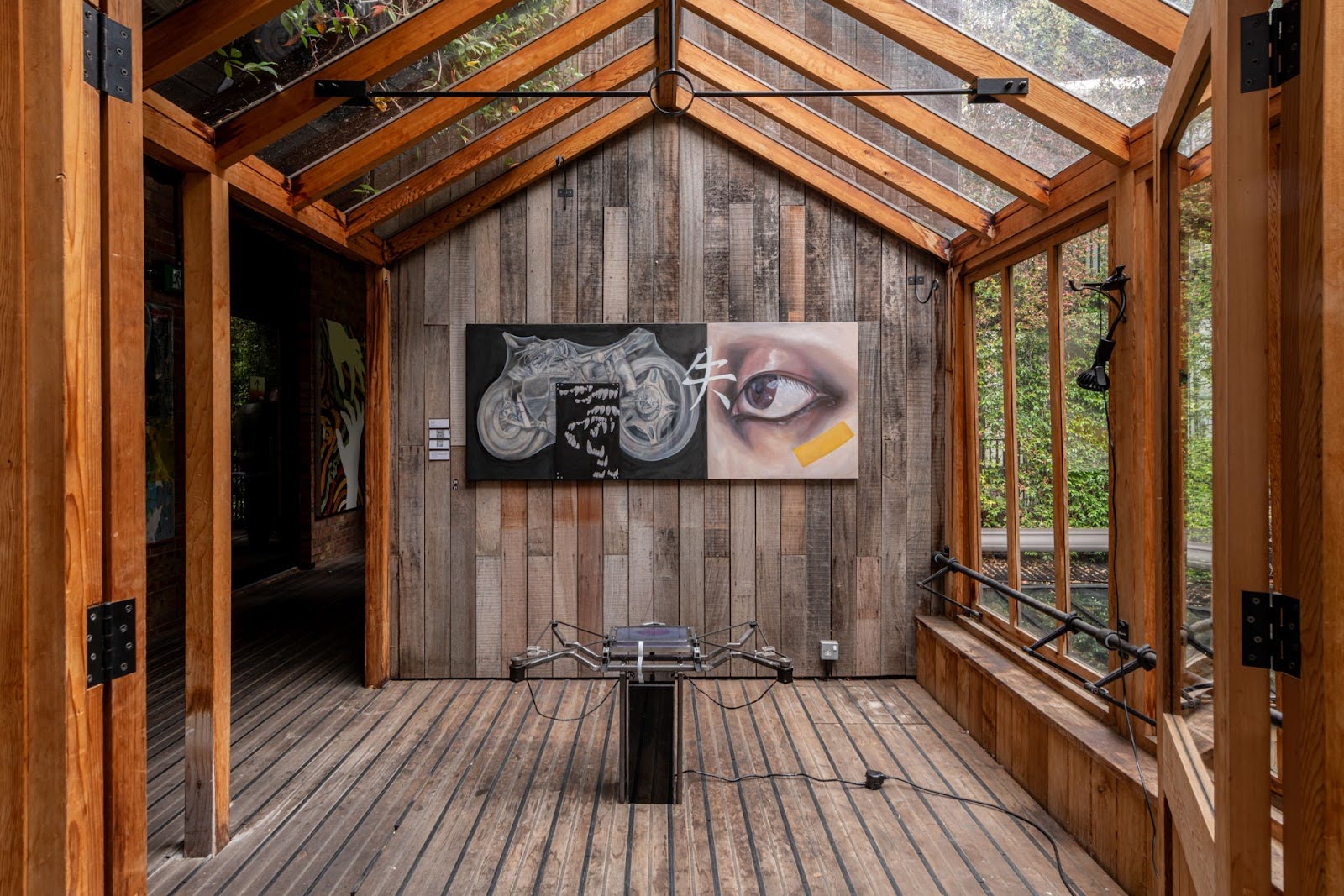
XIFEI ZHANG attends the third edition of Minor Attractions and asks what happens to the contemporary art fair when the gallery booth is replaced by an intimate hotel room.
Four floors of endless curiosities. As one wanders around the Mandrake Hotel in London, one might find oneself perpetually asking whether what one is staring at is a work of art or not. The hotel’s interior, with its elegance and contemporary flair, blends in with the pieces on show—and vice versa.
The week-long art fair Minor Attractions invites global commercial galleries and non-profit art spaces to bring exciting and daring artworks to its stage, spanning fifteen hotel rooms. It is a space for artists, curators and collectors to mingle and connect with their “neighbour” dorm. Works of art are displayed within the rooms, along staircases—keep an eye out and mind the step!—and out on the terrace, which overlooks an urban jungle. It is a space for the common passer-by to encounter some of the most exciting pieces of contemporary art today—the fair being open to everyone free of charge. Meanwhile the quality of the work is high, constantly pushing the boundaries of even the most contemporary definitions of art. This year witnessed the presentation of Turner Prize winner Mark Wallinger’s video work MARK (2010), shown in London for the first time, on the ground floor of the hotel.
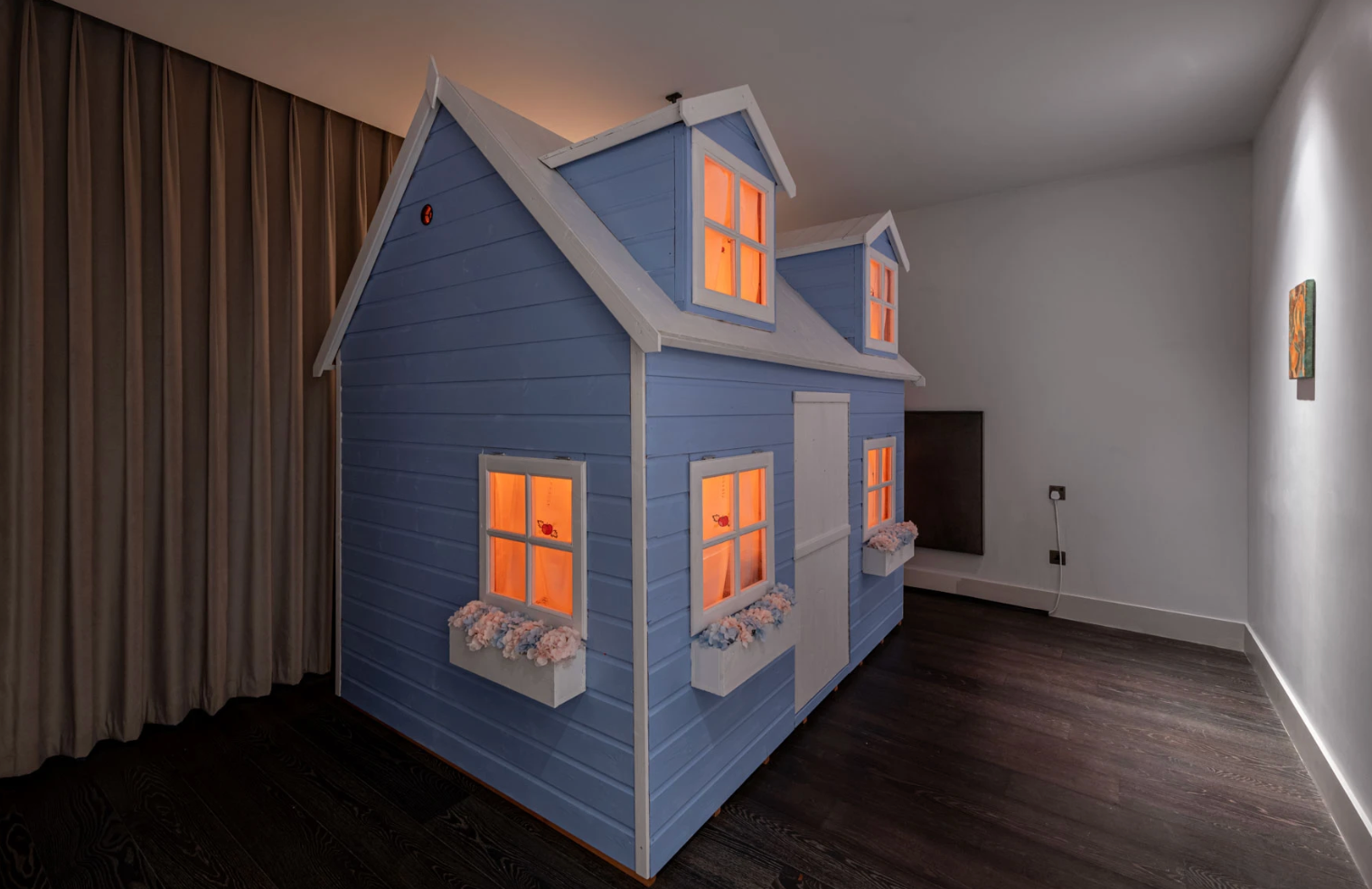
My first stop is room 04. Upon entering the hotel room, one is sure not to miss Milk Teeth, Wildfire (2025)—a giant playhouse dominating the space. A warm glow radiates from within—the room’s sole source of light—accompanied by gentle crackling sounds in the background. Toasted marshmallows by the fireplace, anyone? The installation conveys darker undertones, though the child next to me certainly is more excited about the playhouse itself. There is, it seems, something here for everyone. A large crowd gathers around Comfort Zone (2025), a video work by Amelie McKee and Melle Nieling. Played on a tiny tablet connected to an old-school DVD player, this small-scale installation is displayed on the bathroom sink. The premise hinges on a Sims family trying to deal with a fire in their cottagecore home. Help is NOT on the way. This piece is part of the multimedia work Afterfire (2025) by McKee and Nieling, which interrogates the power dynamics of play spaces.
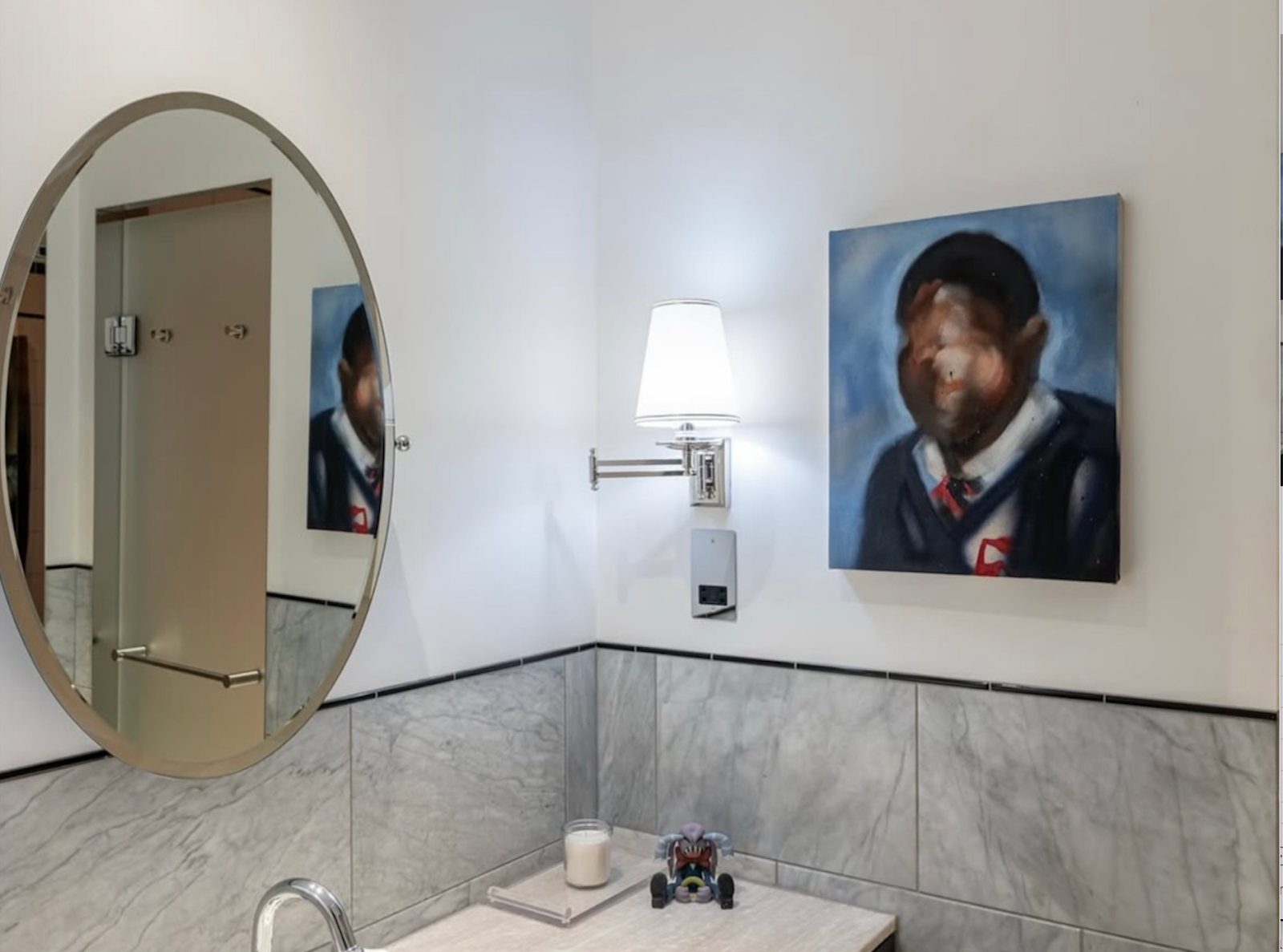
The idea of hosting an art fair in a hotel is as exciting as the works on display. With each room belonging to an individual gallery, all of the pieces housed within them are up for sale. Inside the room claimed by Bolanle Contemporary, I am met with what, at first glance, seems to be a university student’s wardrobe (minus the mess, of course), its shelves neatly stacked with collectibles and old PlayStation discs. A shrine for old memories—a glimpse into the artist’s world. This is part of Ramone ‘K’ Anderson’s installation Moving on Swiftly (2025), which interrogates the transitory nature of being. His spray paint paintings are bold yet intimate, drawing on personal histories, past relationships and former selves. In the bathroom, I encounter a portrait of a young boy wearing a school uniform placed next to the bathroom mirror—yet his face is wiped out. In this moment, I notice an interplay and subtle dialogue between the artist and the exhibition space that contributes to the development of the artist’s theme of loss and exploration of the past. Other exhibitors have also turned exhibiting space into an installation site. In room 03, the innovative video installations by Dutch artist Quintus Glerum comment on humanity in the hyper-digital age. One might be frightened by seeing ‘smoke’ billowing out of a plug socket. Fortunately, as part of Glerum’s work, it is constrained within a frame.
On the top floor, in room 29, I am presented with John Robinson’s tapestry-like wall-display of paintings. Channelling the belief that art is for everyone, Robinson paints on cardboard, yet his paintings still maintain a fragile, delicate quality. With a mix of portraits and other images of intimate moments, the artist infuses the scenes he depicts with a sense of solemnity. The visitors are encouraged to connect with the exhibition space by looking through a collection of paintings on the hotel bed, as though flicking through vinyl records.
This year’s fair welcomed over seventy galleries. Minor Attractions is as exciting to gallerists and artists as it is to collectors and enjoyers of art, providing a new and innovative way of experiencing art. By collapsing the distance between commerce and intimacy, the event reframes the art fair as something less transactional. In these borrowed hotel rooms and spaces, art becomes less an object to be observed and more an encounter to stumble upon.
Featured image: Miles Scharff; Ruby Chen, Paradise Lost, 2025. Installation view at LUmkA, Minor Attractions, London, 2025. Courtesy of Studio Adamson.